
Is Traditional Boxing or Muay Thai Better When Transitioning to MMA?
Mixed martial arts as a combat sport has a long history of drawing in fighters who have a background in only one martial art. However, not all martial arts equally prepare fighters for the experience, and some fighters may start their MMA journey at a greater advantage than others. Of course, this begs the question: Is there one martial art that gives you more of an advantage than others?
In this post, we’ll look at just two martial arts: Muay Thai and traditional Western boxing.

Western Boxing
As Coach Firas Zahabi of Tristar Gym in Montreal notes in the above video, one of the most common backgrounds in MMA is Western style boxing. Boxers are formidable not only because of their punching ability, but because of their exceptional footwork, balance, and stamina. They are accustomed to dodging and absorbing punches in a way that fighters with a wrestling or jiu-jitsu background might not be, which also gives them a tremendous advantage.
However, Western boxers do not come to the octagon totally prepared for an MMA fight. For one, they lack a ground game, so they may struggle when taken to the ground. Second, and unlike Muay Thai, they do not use leg strikes.
Muay Thai
Known as the “Art of Eight Limbs,” Muay Thai (or Thai-style boxing) teaches fighters to use their fists, elbows, knees, and shins or feet. Like boxers, fighters trained in Muay Thai can give and take strikes, have great balance, and they are usually in exceptional shape. Also like Western boxers, Muay Thai fighters do not have much in terms of a ground game and may struggle when going up against grapplers.
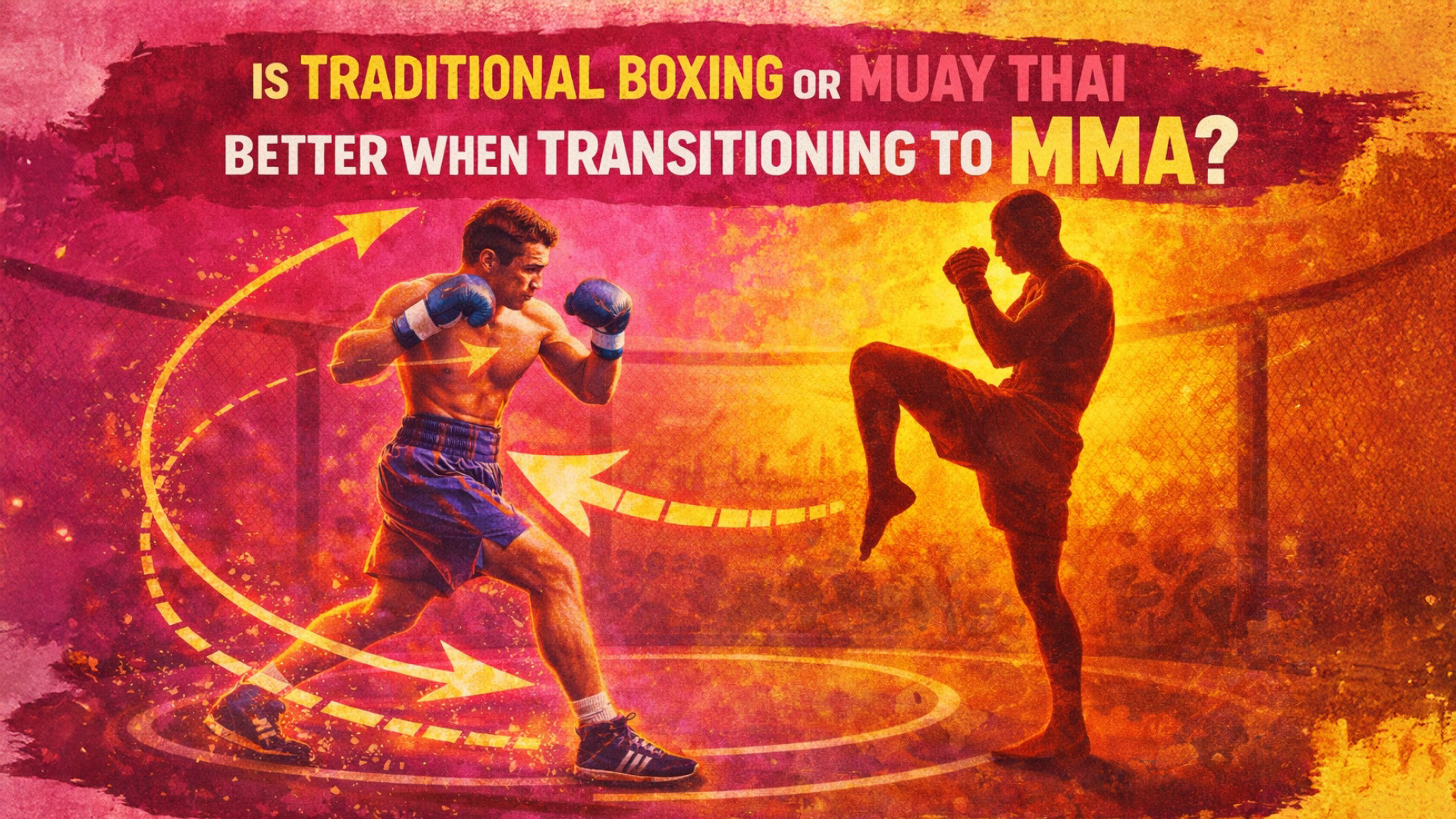
One of the other major differences between Muay Thai fighters and boxers that Coach Firas points out is their footwork. For Firas, this is very important. In Muay Thai fights, there is not a lot of movement around the ring. In Western boxing matches, the fighters are constantly moving around.
Ultimately, he thinks this is one of the reasons why Western boxers have a slight advantage over Muay Thai fighters when transitioning into MMA.
Managing Distance with Footwork
The amount of movement during a fight may not seem all that important at first glance, but Coach Firas explains that it’s really about managing distance. Muay Thai fighters and boxers do so in a fundamentally different way, and it affects how fighters strategize their attacks and their defense. In this regard, boxing and MMA tend to be very similar, and Coach Firas thinks this makes it easier for boxers to start training MMA.
As he elaborates, circling too much in Muay Thai can land you in the corner. If you’re stuck in the corner in Muay Thai, you are immediately at a major disadvantage and may end up taking a lot of damage, particularly from kicks, which are the primary strikes in Muay Thai. Consequently, Muay Thai fighters are trained not to circle. Instead, Muay Thai fighters tend to favor more direct, forward-and-backward movements.
Within the octagon, there are no real corners, so circling is more common to avoid power strikes and to set up attacks.
This is not to say that the footwork for MMA-style fighting and for Western boxing is the same. MMA fighters need to be on guard against takedowns and kicks, so they typically have a more squared stance. Western boxers favor what is known as a bladed stance, which means they are more sideways-oriented to better evade punches and protect their torso. It also allows them to use their hips to give their strikes more power.
Finding Balance When Crossing Over
Regardless of your background, crossing over into MMA from Muay Thai or boxing takes a lot of time to get used to, but it can be worth it if you want to become a more well-rounded fighter. One way to help with the transition is to independently take classes in jiu-jitsu or another grappling art. Even if you do not become an expert, these classes will allow you to become more comfortable when the fight goes to the ground while also teaching you how to better execute and defend against submission holds.