
Is Drilling the Best Way to Learn Jiu-Jitsu?
For decades, most people have learned jiu-jitsu the same way: line up, watch the technique, drill it back and forth for a few rounds, then spar. It’s a model that’s stood the test of time and continues to feel both efficient and productive.
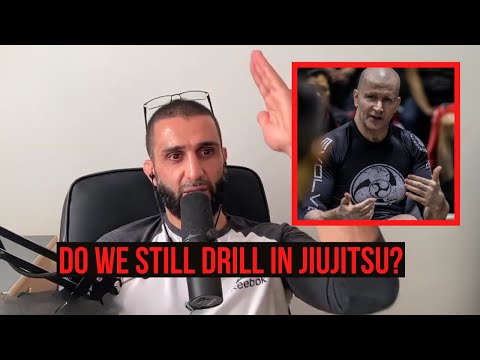
In the below video, Coach Firas Zahabi of Tristar Gym questions the wisdom of continuing to rely on this method. Specifically, he asks if the ecological approach is more effective than static drilling when training martial arts.
Why Drill?
Before diving into ecological training, it’s important to note why people have relied on drilling for so long. First and foremost, it teaches muscle memory. Muscle memory is an integral part of making talent consistent. It doesn’t matter if you’re throwing a baseball, playing a piano, or setting up a guillotine choke, repetition will make the movements smoother and the person performing the movement more competent.
Secondly, drilling can help with skill refinement. If there is a particular move that is difficult, breaking it down into steps, and then practicing those steps can help some people better understand the technique. Particularly for beginners, this approach can help them get acquainted with common movements and even start to understand how certain techniques are sequenced.
Drilling can also help people with physical conditioning and warming-up in a way that isn’t just stretching or doing cardio.
What Is the Ecological Approach?
Conventional drilling involves repeating isolated techniques to establish muscle memory. When performed with different partners, even drilling where that partner is passive will help you develop a feel for the minor variations that come from engaging with different body types.
In contrast, the ecological approach refers to a framework that emphasizes learning by engaging with a resisting opponent in a limited setting. The core idea is that skills are best developed when a fighter is forced to adapt to varied and realistic constraints that are like a real-world fight scenario. Whereas drilling involves repeating a technique and limits variation, the ecological approach gives them room to discover solutions organically and in the moment.
It should be noted that training scenarios do mirror real-world scenarios, but the coach may set different constraints on the two fighters. One may start from the mount and be tasked with figuring out how to finish an armbar, while the other defends or escapes. As another example, the coach may limit the types of attacks or defenses that the fighters can use. Ultimately, the goal is to use these limitations and constraints to focus on learning and improving one technique, while also teaching the fighter how to come up with their own solutions.
Drilling’s Tidiness Is a Limitation
One of the problems with drilling is that it’s tidy. It gives us the illusion of certainty. You can count reps. You can say you “got through” the move ten times. Ecological training, by contrast, is messy. You fail more. You get stuck. You don’t always look good.
As Coach Firas notes, drilling can allow you to look like Steven Segal. However, you’re not going to get to the level of Muhammad Ali by drilling alone. As Firas says, “He’s bred in the chaos.” Ali knew how to read body language and adapt to his opponents more than just how to throw a punch.
That kind of dynamic training is necessary in every martial art and every sport. Even though all sports require athletes to be consistent with their mechanics, athletes also have to be responsive to the chaos. Technique divorced from context doesn’t transfer cleanly to live rounds. The nervous system doesn’t learn in isolation; it learns under pressure, under variability, and under uncertainty.
What Students Should Know
The ecological approach (which may sometimes be called “constraints-based training”) requires intentional and proactive coaching, so it’s vital that you trust any instructor who claims that this is their methodology of choice. The coach helps fighters better understand blind spots in their game and then pushes them to work through scenarios that shore up those weaknesses, so you have to trust that the coach will really invest in learning your game and making recommendations on how to fix it.
For students, this shift demands maturity. You’ll feel clumsy. You’ll feel exposed. That’s not a sign you’re regressing. It’s a sign that the room is honest. Second, you have to become a better partner.
Ecological training only works if everyone involved—whether your partner today or your partner tomorrow—are committed to sharpening one other’s game. The better your partner gets, the more they’ll be able to challenge you and vice versa. In the end, everyone gets better.